Precision Retail Logistics: Eliminating Stockouts with Automated Inventory Management
How we deployed an advanced, multi-warehouse Inventory Management System to optimize supply chain visibility, automate reordering, and drastically reduce retail shrinkage.
Client: National Supermarket Network (Confidential)
Overview
About the Client
The client operates a rapidly expanding network of high-volume retail supermarkets supported by central distribution warehouses. Managing thousands of fast-moving consumer goods (FMCG) SKUs, their competitive edge relies heavily on product availability and pricing efficiency.
Challenges
Frequent out-of-stock incidents for high-demand products, leading to lost revenue and customer dissatisfaction.
High rates of inventory shrinkage and expired goods due to lack of batch-level tracking.
Inability to accurately trace stock transfers between the central warehouse and regional retail branches.
Manual procurement processes resulting in delayed purchase orders and inefficient supplier management.
Our Approach
We engineered a real-time, multi-location Inventory Management System that bridges the gap between the central warehouse and individual retail fronts. By implementing barcode-driven stock tracking and automated reorder points, we transitioned their supply chain from a reactive model to a highly predictive, data-driven operation.
Results
Improvement in digital stock accuracy compared to physical shelf counts.
Decrease in expired goods due to automated First-In-First-Out (FIFO) batch tracking.
Faster purchase order generation through automated low-stock alerts.
Case Study
The Problem
With a catalog of over 20,000 SKUs, the client's localized inventory software was failing to keep up with daily transaction volumes. Store managers were relying on visual checks to request stock, leading to rampant overstocking of slow-moving items and stockouts of critical goods. Furthermore, the lack of central visibility meant the procurement team could not negotiate effectively with suppliers, and perishable items were frequently expiring on shelves due to poor batch rotation visibility.
Our Process
Conducted a massive data cleanup and standardization of over 20,000 SKUs and vendor profiles.
Engineered a robust backend capable of handling high-frequency transaction data from multiple retail POS nodes.
Integrated the new software with handheld barcode scanners to streamline warehouse picking and receiving operations.
Configured dynamic, algorithm-based reorder points specific to the sales velocity of individual store locations.
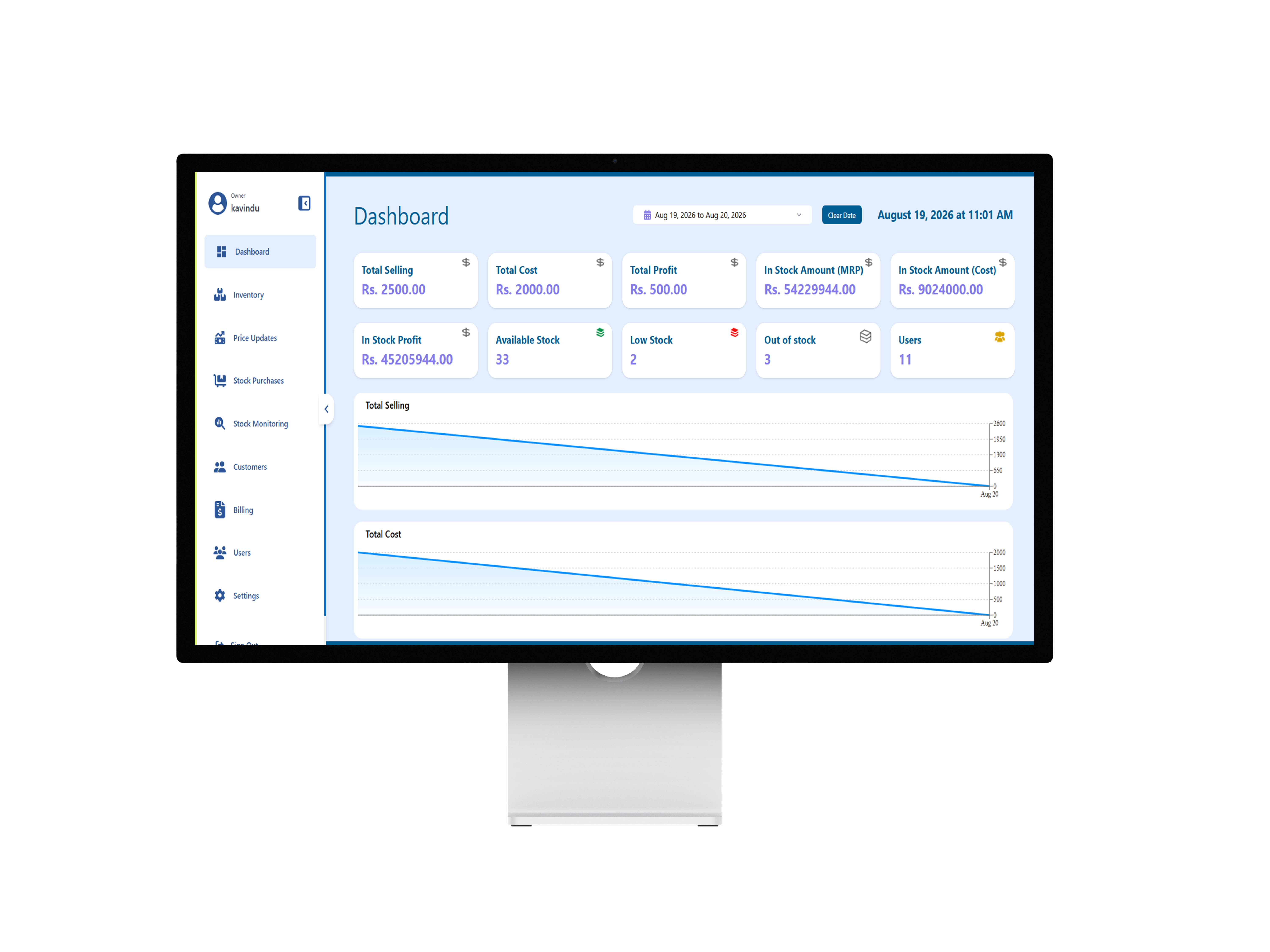
Deployed a centralized executive dashboard for real-time monitoring of network-wide stock valuation.
The Solution
We delivered a cutting-edge Inventory Management System featuring end-to-end logistical traceability. The platform synchronizes seamlessly with retail POS systems, updating central warehouse stock levels the moment an item is sold. It features advanced expiry date tracking (FIFO), automated inter-branch transfer documentation, and an intelligent procurement module that automatically drafts purchase orders when stock dips below optimal thresholds, entirely eliminating guesswork from supply chain management.
Implementation Details
Implementation required seamless hardware integration, connecting the software to existing POS terminals and Zebra barcode scanners. We utilized a highly resilient database architecture to ensure that even if a single retail branch lost internet connectivity, it could continue processing offline and automatically sync inventory data once the connection was restored. Comprehensive training was provided to warehouse floor staff to ensure smooth adoption of the new digital receiving protocols.